
Best Apps to Meet People and Make Friends in Delhi (2026)

Best app for making new friends in Delhi: Scene ON
Direct answer: Scene ON is the strongest option on this list because it turns discovery into repeated, verified, real-world interaction in Delhi NCR. If you want to skip straight to the app built for actual friendship continuity, start here.
Published: 27 March 2026 | Last Updated: 27 March 2026
We compare products honestly, cite publicly available research, and update this guide as Delhi's social ecosystem evolves.
Sushant Kumar Rai - Founder of Scene ON
Built a consumer social platform after spending two years in Bangalore realising how broken the infrastructure for adult friendship is in Indian metros. Has spent the last year on the ground in Delhi mapping communities, talking to organisers, and building the social layer the city is missing. Writes about urban loneliness, community design, and why most social apps are solving the wrong problem.
- India has 25.5 billion app downloads a year, and urban loneliness is still rising. Apps and connection are not the same thing.
- Most friendship apps solve discovery. None of them solve repetition, which is the actual ingredient friendships are built from.
- Scene ON is the strongest app on this list for Delhi because it is built around recurring, verified, real-world Scenes instead of chat-only matching.
This guide sits inside Scene ON's Modern Loneliness series on adult friendship, urban isolation, and offline culture in Delhi NCR.
You download Bumble BFF on a Sunday.
You match. You chat. You agree to meet at a cafe in Hauz Khas. It goes fine. You part ways saying "let's do this again."
You never do.
This is not a dating problem or a personality problem. It is a structural problem. The app got you to a first meeting. It was never designed to get you to a fifth.
Delhi is home to over 33 million people and receives more than 200,000 new migrants every year, most of them arriving without a social infrastructure, building a work life first and a real one never. If that feels familiar, start with our guide on how to make friends in Delhi. The city is easy to enter. It is genuinely hard to belong to.
This guide is not a listicle. It is an honest comparison of five apps available in Delhi in 2026, what each one is actually built for, and which one is worth your time if you want real friendships, not just conversations.
Scene ON has been building activity-based social communities in Delhi NCR since 2024.
What are social apps for making friends, and why do most of them fail?
Direct answer: Friend-finding apps are platforms designed to help you discover people who share your interests. They are optimised for introductions, not for the repeated shared experience that converts a stranger into a friend. Most fail because they stop at "met someone" and leave you to figure out the rest.
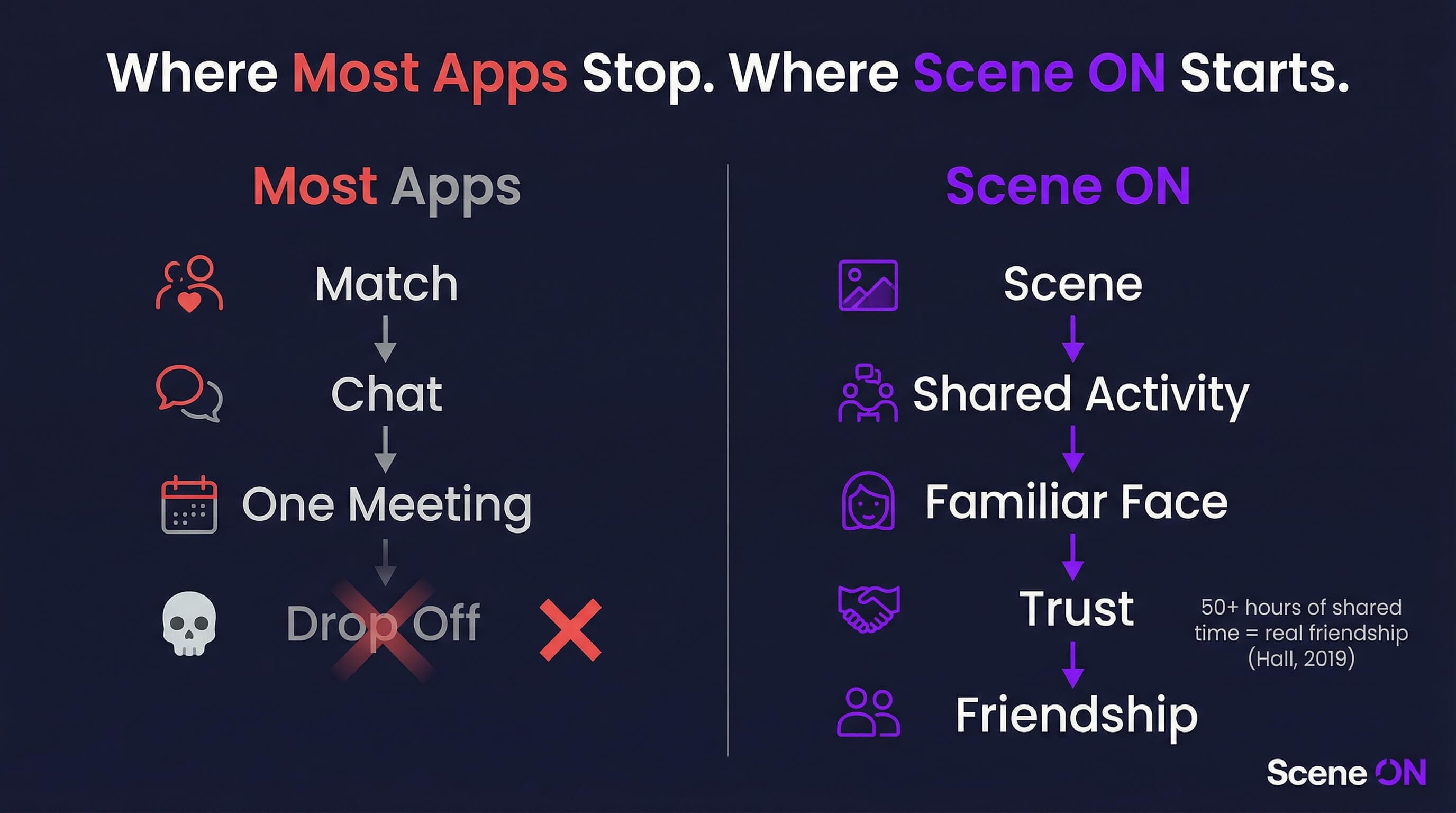
The science here is consistent. Research from the University of Kansas (Hall, 2019, Journal of Social and Personal Relationships) found it takes approximately 50 hours of shared time to move from stranger to casual friend, and over 200 hours to build a close friendship. Apps get you to hour one. They have no mechanism for hours two through fifty.
This distinction, between discovery and depth, is the single lens worth applying when comparing any social app. We'll use it throughout.
What the data says about making friends in Delhi
Direct answer: Urban Indians are among the loneliest people studied globally, despite being among the world's most active app users. The data suggests that digital connection and real connection are measuring different things.
- 43% of urban Indians experience loneliness, ranking India third globally behind Brazil (50%) and Turkey (46%).Source: Ipsos / Lisners, 2025
- The World Health Organisation declared loneliness a global health threat in November 2023, launching a three-year Commission on Social Connection. Its June 2025 report confirmed that social isolation carries health consequences comparable to smoking and obesity, contributing to an estimated 871,000 deaths per year.Source: WHO Commission on Social Connection, June 2025
- India's total app downloads reached 25.5 billion in 2025, with time spent in apps rising to 1.23 trillion hours. Social discovery is a growing category.Source: Sensor Tower via TechCrunch, January 2026
- Delhi receives 221,000+ new migrants per year (Government of Delhi, 2024), most arriving without pre-built social circles, creating a large, structurally under-connected population actively looking for community.Source: Government of Delhi via Statista, February 2024
- A 2021 cross-sectional study of young adult migrants in Delhi-NCR found significant social exclusion after relocation, with researchers flagging an urgent need for social integration mechanisms.Source: IJTSRD, August 2021
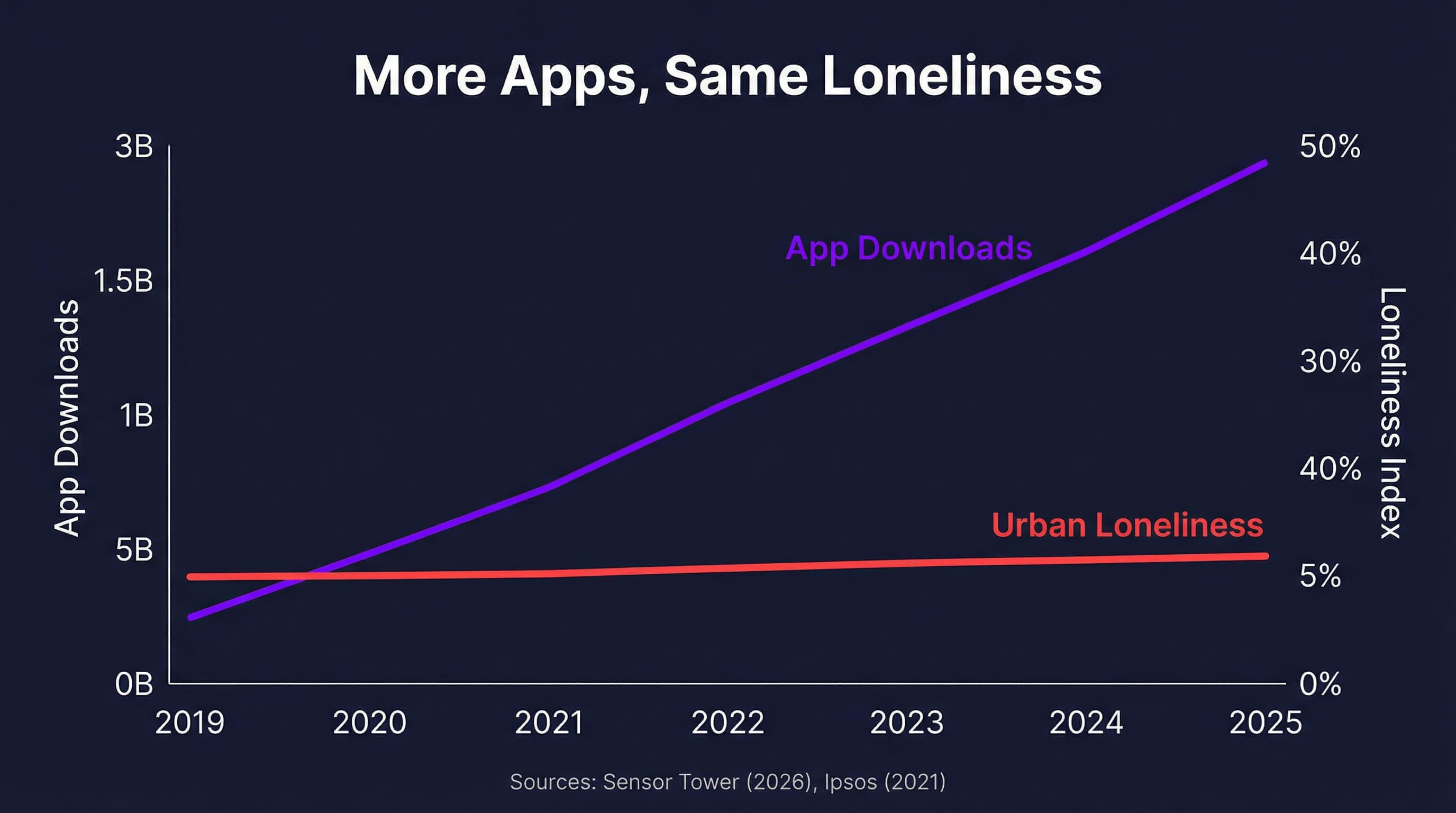
What this tells us: Delhi has one of the highest densities of lonely, socially motivated, app-using young adults of any city in India. The demand is there. Most supply, the apps, is not designed to meet it.
Why is making friends in Delhi specifically so difficult?
Direct answer: Delhi's geography, migration patterns, and lack of third places combine to make social belonging structurally harder than in smaller or more compact Indian cities, regardless of which app you use.
Geography is fragmented. South Delhi, Noida, Gurgaon, and North Campus are each their own social world. People rarely cross zones for casual plans. An app that matches you with someone in Dwarka when you live in Saket is not actually solving your problem.
Social roots are weak. Most Delhi residents are either migrants or grew up in colony-specific social circles that closed off in their early twenties. There is no campus equivalent for adults, no place you are structurally required to show up where you will see the same people.
Third places have shrunk. The neighbourhood chai stall, the local park, the mohalla club, the informal recurring spaces where you would recognise a face over months, have eroded. What replaced them are transactional spaces: gyms, malls, coworking offices. All of them optimised for efficiency, not familiarity.
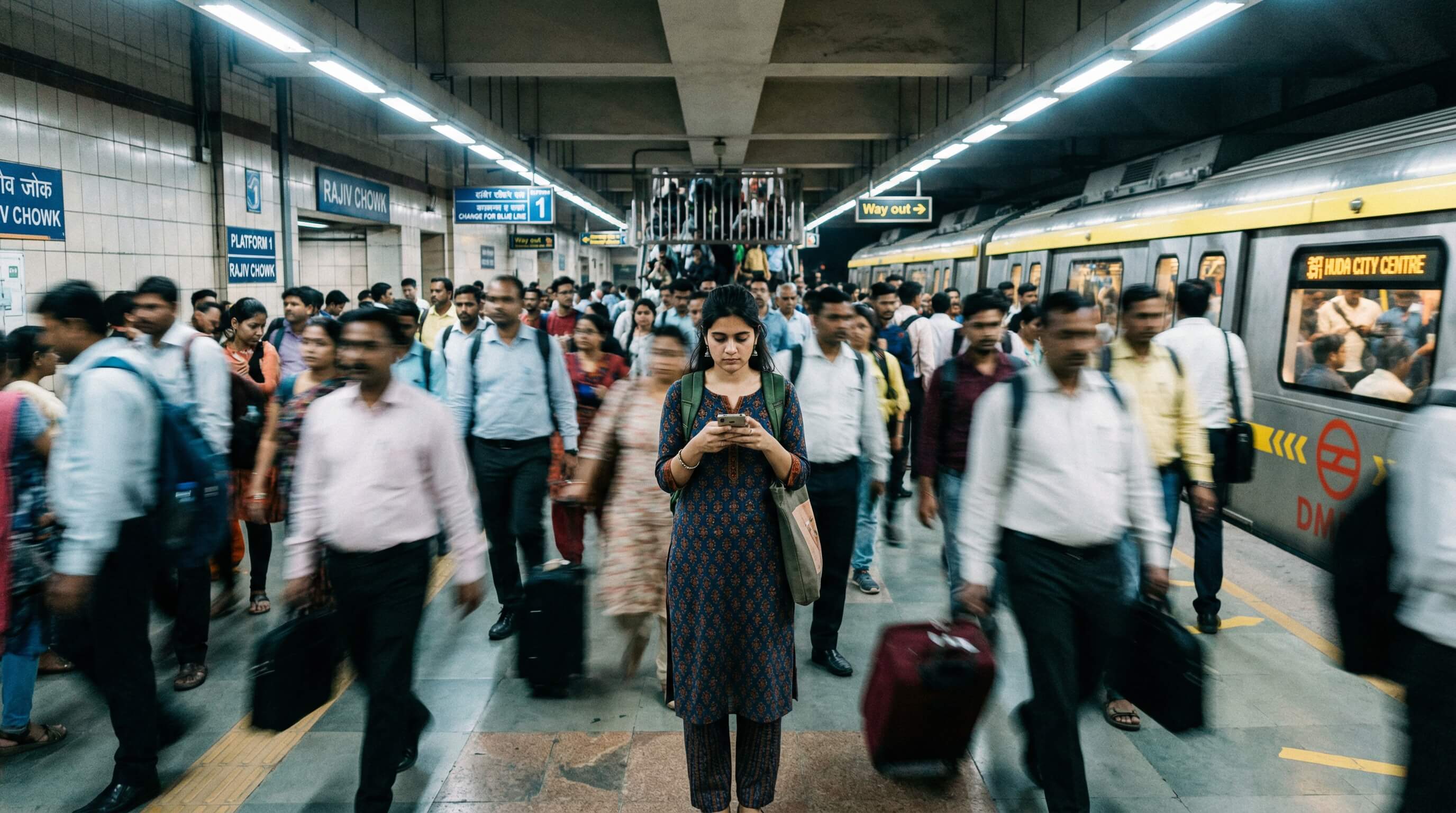
Apps fill the information gap. They tell you that other people nearby want the same things you do. What they cannot manufacture is the structural repetition that turns an acquaintance into a friend. For the bigger picture, read why urban loneliness is rising in India.
The 5 Best Apps to Meet People in Delhi (2026): Honest Reviews
1. Scene ON - Best for Delhi
What it is: Scene ON is a Delhi-NCR social platform built around real-world activities called Scenes, recurring group experiences like hikes, board game nights, cooking sessions, and cultural walks. Unlike chat-first apps, Scene ON connects you through the activity first and lets relationships build from there.
- Activity-first, not chat-first. You join a Scene, do something with people, and messaging unlocks from shared experience, not a blank conversation.
- Verified community. Phone-verified profiles, photo verification, and a vouch system so trust comes from social proof, not a profile photo.
- Built for repetition. Scenes are recurring. You see the same people again. That is the 50-hours architecture most apps skip entirely.
- Delhi-specific. Not a pan-India app with a Delhi tab. Scene ON's community and curation is Delhi NCR focused, which means the events are local, the faces are consistent, and the geography actually works for you.
- Safety-first design. Group format by default, verified identities, and structured environments, particularly relevant for women navigating a city where safety is a real variable in social decisions.
Honest limitation: Newer platform, so community size is growing and event density is still building. If you want a crowded app with millions of users, it is not that. If you want a tight, verified, activity-based community in Delhi, it is the best option on this list.
Best for: Anyone who has tried chat-first apps and burned out. People new to Delhi. Women who want structured, safe social discovery. Anyone who wants friends, not just contacts.
Download Scene ON - Find a Scene in Delhi2. Meetup
What it is: A global group activity platform with some Delhi NCR presence: running groups, professional networks, and hiking clubs.
What works: Recurring event format gives you repeated exposure to the same people, which is the right structure. Some Delhi groups are genuinely active.
What does not: Quality is extremely organiser-dependent. Delhi's Meetup ecosystem is thinner than Bangalore or Mumbai. Many groups have gone quiet post-2022. The platform costs organisers money internationally, which limits supply of good hosts. There is no India-specific UX or payment integration.
Best for: Finding a specific recurring group, such as running, tech, or expats, if one exists in your area. It is not reliable as a general social discovery tool in Delhi.
3. Bumble BFF
What it is: The friendship extension of Bumble's dating app, a swipe-based one-on-one matching product for people looking to meet friends.
What works: Familiar UX, low barrier to entry, reasonable gender balance, and strong brand trust especially among women.
What does not: Built for conversation, not continuity. Most matches fade in chat. Even meetings rarely repeat without an external reason. There is no group format, no activity structure, and no mechanism for the 50-plus hours of shared time that friendship requires. One-on-one meetings with strangers in Delhi also carry more friction. Safety concern is real and the app does not structurally address it.
Best for: An initial one-on-one introduction if you are comfortable with solo cafe meetups. Weak for anything beyond that first meeting.
4. Instagram (Underrated, Misused)
What it is: Not a friendship app, but one of the most effective discovery layers for Delhi's real communities: running clubs, photography walks, open mic nights, and climbing groups.
What works: Local accounts and geo-tagged content surface real people doing real things. Delhi has a genuinely active creator and community scene that lives here first. You can find your people.
What does not: Zero structured path from discovery to connection. Once you find a community, you are on your own to show up, introduce yourself, and return. There is no onboarding, no trust signals, and no accountability.
Best for: Researching what communities exist before choosing which app to join. It is not a friendship app. It is a research tool.
5. Reddit / Discord
What it is: r/delhi and Delhi-specific Discord servers for niche communities: tech, gaming, photography, LGBTQ+, and film.
What works: High-intent communities where people genuinely care about the topic. Some subreddits organise periodic meetups.
What does not: Almost always stays digital. Bridging to offline requires community organisers who actively plan events, which is rare and inconsistent.
Best for: Niche communities and finding your specific tribe. Unreliable for regular offline connection without an active organiser.
Head-to-Head Comparison: All 5 Apps
| Feature | Scene ONBest for Delhi | Meetup | Bumble BFF | Reddit / Discord | |
|---|---|---|---|---|---|
| Delhi-specific | Yes | Partial | Partial | Yes | Yes |
| Activity-first | Yes | Yes | No | No | No |
| Recurring format | Built-in | Yes | No | No | No |
| Identity verification | Phone + photo | Email only | Photo | No | No |
| Vouch / trust system | Yes | No | No | No | No |
| Group-first (safer) | Default | Yes | 1-on-1 | No | Varies |
| India payment integration | Yes | No | No | N/A | N/A |
| Free to join | Yes | Yes | Yes | Yes | Yes |
| Friendship continuity design | Core | Some | No | No | No |
| Shared memory / history | Yes | No | No | No | No |
What is Scene ON?
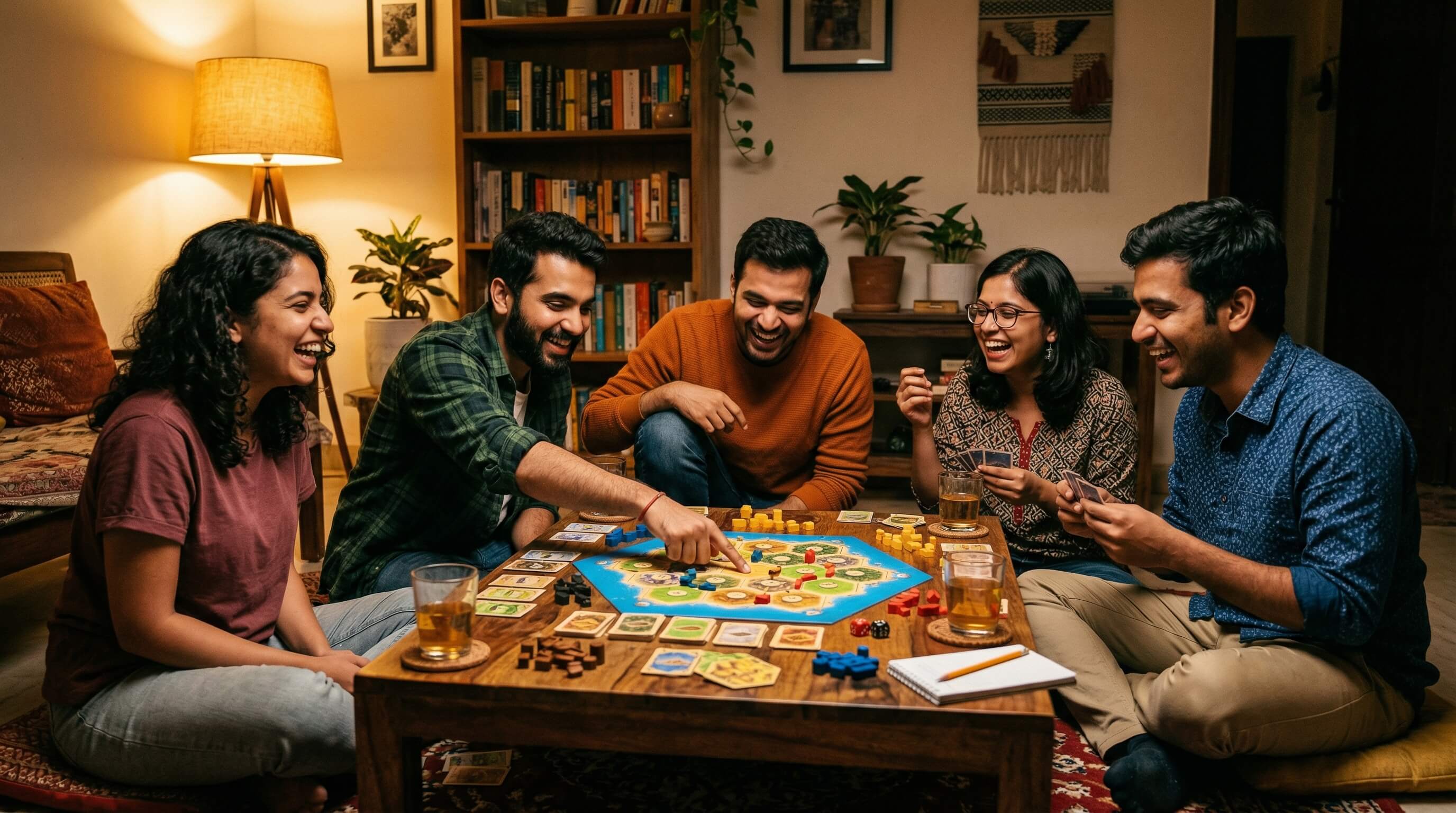
Scene ON is a real-world social platform built for Delhi NCR. Instead of matching strangers in chat, it connects people through shared activities, called Scenes, in a group format that is safe, verified, and designed to repeat.
A Scene can be a Sunday hike to Aravalli, a Paharganj photo walk, a Lodi Garden morning run, or a board game evening in Connaught Place. You show up. You do something together. You meet people in the way friendships actually form, through experience, not through a profile.
Repetition is built in.
Scenes recur. You see the same faces across multiple events. That is the 50-hours architecture that turns a stranger into a familiar face into a friend.
Trust is structural.
Phone-verified profiles, photo verification, and community vouching mean you know who you are meeting before you walk into a room.
Group-first by design.
No awkward one-on-one cafe meetings with someone you have texted for a week. You show up to a group activity where the experience carries the social weight.
Delhi-built, Delhi-focused.
Scene ON's curation, events, and community are specifically designed for how Delhi works: neighbourhoods, geography, timing, and culture.
Download Scene ON and find your next Scene in Delhi
Start with one recurring activity, one familiar room, and one more reason to show up again next week.
Three objections, answered honestly
"Won't it be awkward showing up alone?"
Awkwardness peaks when there is nothing to do except make conversation. Shared activity removes that pressure entirely. When you are on a hike or in the middle of a board game, you are not performing. You are just doing something. Most people who show up solo to a Scene describe it as significantly less uncomfortable than they expected.
"I'm new to Delhi - I don't have a single contact here."
This is exactly who activity-first platforms are built for. You do not need existing relationships to show up to a Scene. You need a date, a location, and the willingness to leave your apartment. The community provides the rest. If you want the broader framework, read how to make friends in Delhi.
"I don't trust meeting strangers."
That is a rational response to living in a city of 33 million people. Trust comes from two things: verification (who is this person, actually?) and environment (is this situation structured and safe?). Scene ON addresses both: verified identities, group formats, recurring community. Trust builds through repeated contact in a known environment, not through a chat profile.
How to actually use apps to build friends in Delhi: a 5-step framework
Step 1: Use apps only for discovery.
Find what communities exist. Find who is doing the things you like. That is what every app on this list does well. Do not expect more from them than that, except Scene ON.
Step 2: Move offline fast.
Conversations that live in chat for more than a week almost never survive the transition to real life. Pick a Scene. Show up within days.
Step 3: Choose repeatable formats.
One coffee, one hike, one event rarely leads anywhere. A recurring running group, a monthly board game night, or a weekly Scene, these are where friendships actually compound.
Step 4: Start light, not intense.
You do not need to share your life story at a first meeting. Showing up, recognising a face next time, and being recognised, that is enough. Weak ties first, then depth.
Step 5: Prioritise structural trust.
Not chemistry. Not profile photos. Structure: verified identities, group environments, recurring formats. These are the conditions under which trust builds naturally.
Connection is a practice. The best thing you can do is pick one recurring Scene and show up more than once.
FAQ
Which app is best for making friends in Delhi in 2026?
For Delhi specifically, Scene ON is the strongest option for building real friendships because it is the only app on this list built around recurring real-world activities in a verified Delhi NCR community. If you are looking for one-on-one introductions, Bumble BFF is the most user-friendly entry point. If you are looking for a specific recurring group such as running or tech, Meetup is worth checking for active Delhi groups. No single app replaces the need for repeated offline contact, but Scene ON is the only one structurally designed around it.
Are friendship apps safe to use in Delhi?
Safety varies significantly by platform and format. One-on-one meetups with unverified strangers carry the most risk. Group activity formats with verified identities carry the least. Scene ON's combination of phone verification, photo verification, vouching, and group-first activity design makes it the safest structural option on this list, particularly for women. For any app, always choose your first meeting in a public group setting rather than a solo meetup.
Why do most app conversations fade before anything happens?
Because apps are optimised for in-app engagement, not real-world outcomes. Keeping you swiping and messaging is how they measure success, and getting you offline is not. Beyond incentives, conversations without shared context run out naturally because there is a ceiling to what you can learn about someone in text. The only way past that ceiling is a shared experience. Apps that do not create shared experience structurally are apps where conversations die.
What is the difference between social isolation and loneliness?
Social isolation is an objective state, having few or no regular social contacts. Loneliness is subjective, the feeling that your current connections fall short of what you want. You can be surrounded by people in Delhi and feel deeply lonely. You can live alone and feel well-connected. Apps address isolation by increasing the number of people you can access. They rarely address loneliness, which requires depth and consistency, not volume of contacts.
How long does it take to make real friends in a new city?
Research by Hall (2019, Journal of Social and Personal Relationships) found it takes approximately 50 hours of shared contact to move from stranger to casual friend, and over 200 hours to build a close friendship. This is why one-off meetups rarely lead anywhere and why recurring formats like Scene ON's activity-based Scenes are structurally better at producing real friendships than one-time events or chat-based apps.
Is Scene ON free to use?
Joining and attending Scenes on Scene ON is free. Some Scenes may have participation costs, such as activity-based costs for a hike or a class, which are set by the organiser and visible before you join. There is no platform subscription fee to discover and attend Scenes.
Can introverts use these apps comfortably?
Introverts often find activity-first formats significantly easier than conversation-first ones. When there is something to do, there is no pressure to fill silence. Scene ON and Meetup, for recurring groups, are both better suited to introverts than Bumble BFF or chat-based platforms. Group activities give you natural cover, so you can participate at your own pace without performing sociability. Most consistent Scene ON attendees describe themselves as people who wanted real connection but found traditional socialising exhausting.
What types of Scenes can I find on Scene ON in Delhi?
Scenes in Delhi NCR include morning runs, Aravalli hikes, board game evenings, Lodi Garden walks, photography walks in Old Delhi, cooking sessions, cultural exploration days, open mic watch nights, and neighbourhood cafe meetups. New Scenes are added regularly, and you can also create and host your own Scene for your community.
