
How to Make Friends in Delhi as an Adult: A 5-Step Action Framework
Published: 20 March 2026 | Last Updated: 20 March 2026
We cite publicly available research and update this guide as new data emerges.
Sushant Kumar Rai — Community builder at Scene ON focused on urban belonging and offline culture in Delhi NCR.
Meet people and make friends on Scene ON
If you want a practical place to start, explore real-world activities, workshops, and group hangouts on Scene ON and turn repeated exposure into actual connection.
- Making friends as an adult is structurally harder — research shows it takes 200+ hours to build a close friendship.
- 43% of urban Indians report feeling lonely at least sometimes.
- The solution is repeated proximity, weak ties, and consistent exposure — not trying harder.
The Real Problem Nobody Admits
Delhi is loud. Crowded. Hyper-social on the surface.
And yet, it is one of the easiest cities to feel invisible in.
You move here for work. For opportunity. For ambition.
Suddenly you are 25, maybe 29, maybe 33. Your old friends are scattered across cities. Work colleagues stay work colleagues. Your weekend plans depend on one flaky WhatsApp group.
And you start wondering:
Is it just me? Or is making friends as an adult actually this hard?
It is not just you.
What Is Loneliness, Actually?
Loneliness is the subjective experience of a gap between the social connections you want and the connections you actually have. It is not the same as being physically alone. You can be surrounded by people and still feel deeply lonely.
This distinction is foundational in social psychology research dating back to Peplau and Perlman's early work on loneliness.
What the Data Says About Urban Loneliness in India
This is not just a vibe. The numbers back it.
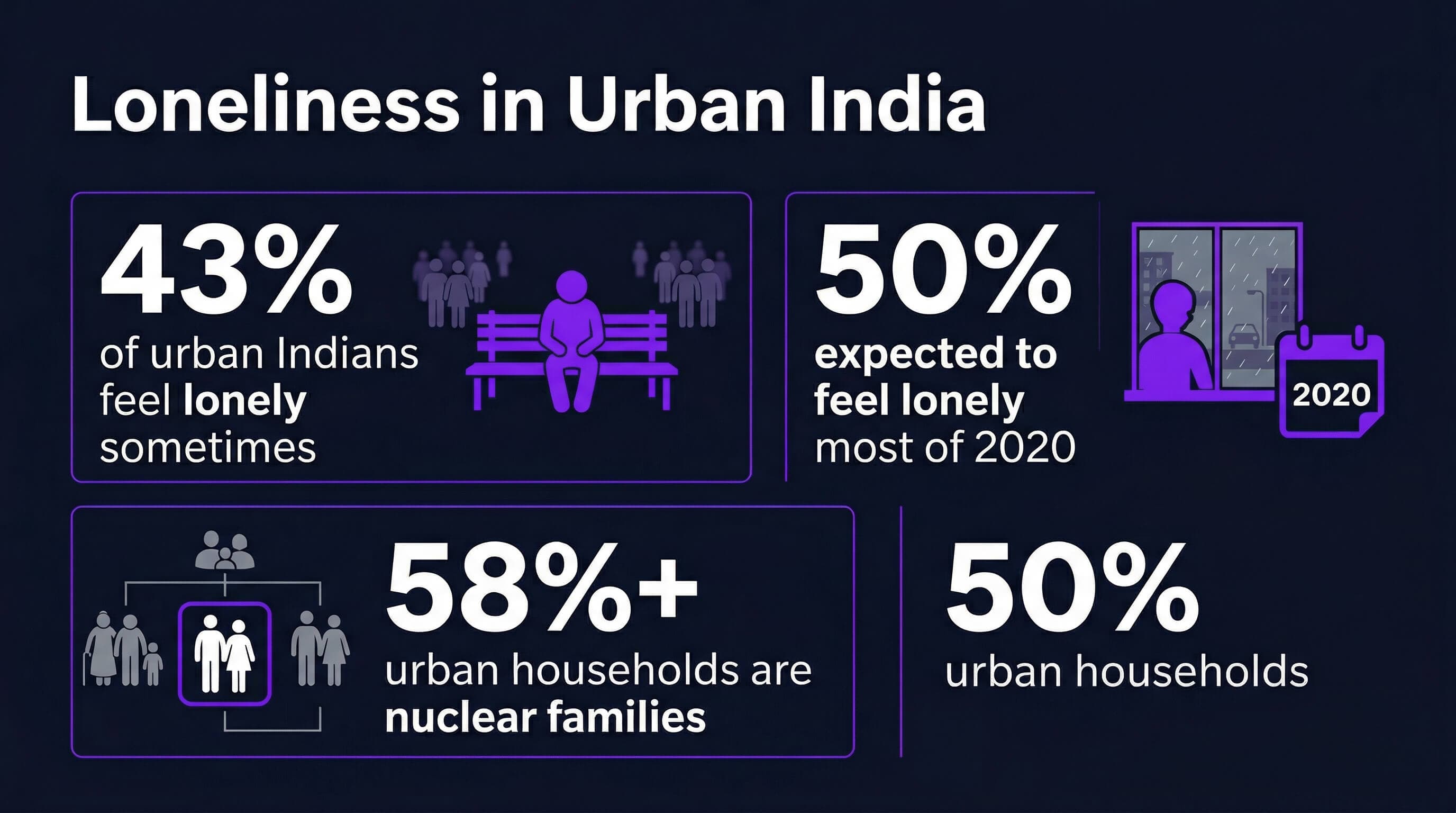
- An Ipsos global survey reported that 43 percent of urban Indians experience loneliness at least sometimes. India ranked among the highest globally for loneliness reporting.
- In a 2020 Ipsos survey, 50 percent of Indian respondents said they expected to feel lonely most of the time that year.
- A 2024 scoping review published on PMC noted that loneliness is increasingly being recognized as a public health issue in India, though still under-researched.
- India has seen a steady rise in nuclear households. Government-linked data shows over 58 percent of Indian households between 2019 and 2021 were nuclear families, especially in urban areas.
Add migration into the mix. Add work-from-home culture. Add digital substitution for social contact.
The structural support systems that once made friendships easier are thinner.
Now here is the part most people miss.
Why Making Friends as an Adult Is Harder Than in College
Research by Jeffrey Hall, published in 2018 in the Journal of Social and Personal Relationships, found that:
- 40 to 60 hours are required to move from acquaintance to casual friend
- 80 to 100 hours to become real friends
- Over 200 hours to become close friends
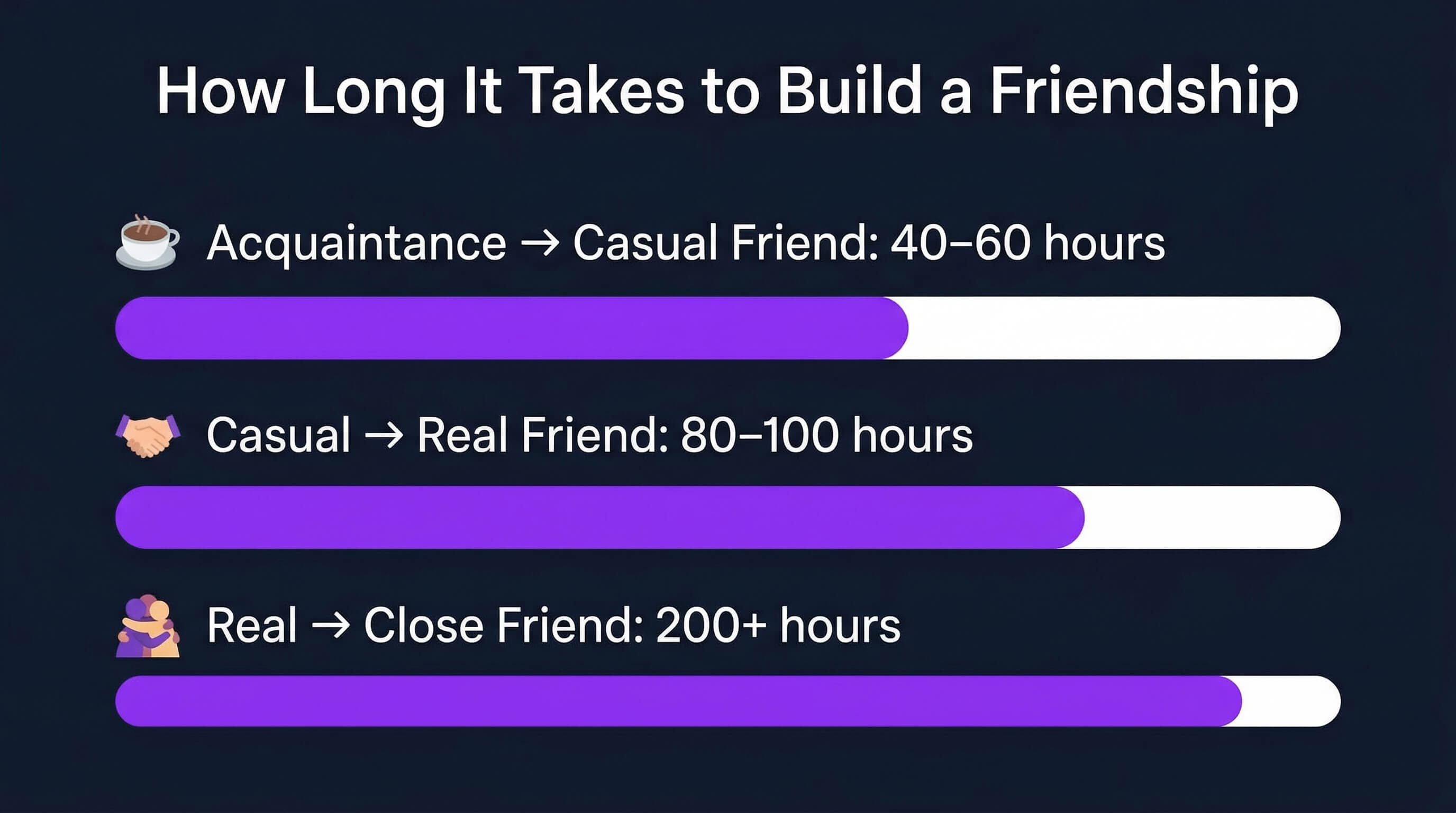
Adults require even more time than college students because college artificially creates repeated exposure.
In Delhi, you do not share hostels. You do not share classes. You do not accidentally spend 3 hours in a canteen every day.
You share deadlines.
And deadlines do not build belonging.
The Weak Ties Advantage
In 1973, sociologist Mark Granovetter introduced the concept of "weak ties."
Weak ties are the barista who knows your order. The person you nod to at your gym. The colleague you talk to outside work once.
Research suggests these loose connections matter. They expand your network beyond your existing circle.
A 2022 study published in Science found that what really creates opportunity is not just weak ties but bridging ties. Connections that link you to entirely different networks.
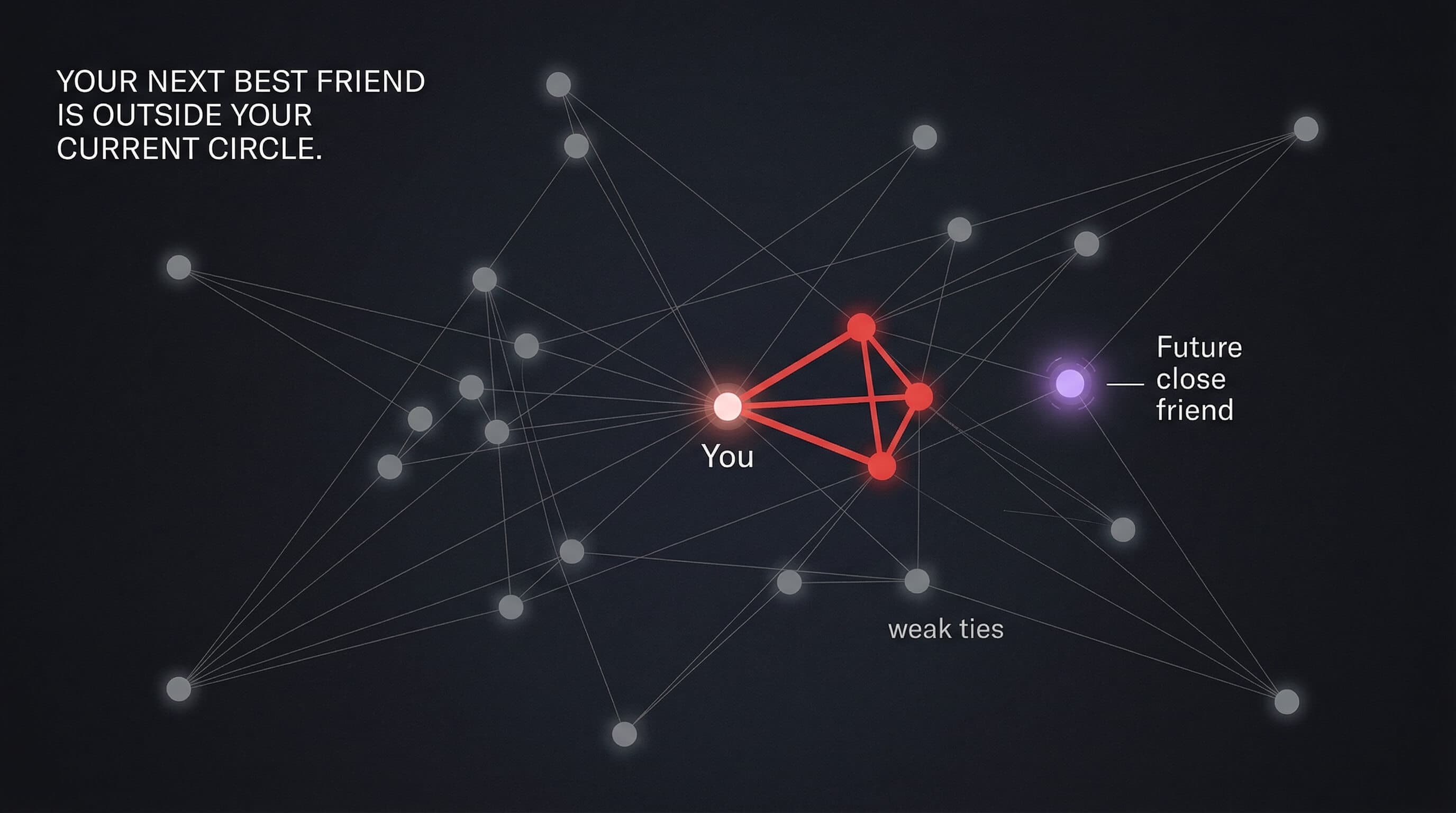
Translation for Delhi:
Your best new friend is unlikely to come from your current circle. They come from overlapping spaces.
Spaces you do not currently enter.
Delhi NCR Makes This Harder
There is no reliable recent data specifically measuring loneliness among 25 to 40 year olds in Delhi NCR. That gap itself is telling.
But consider the structure:
- Millions migrate into Delhi NCR for work
- Nuclear households dominate
- Commute times are long
- Social life is often gated by geography
South Delhi is not Gurgaon. Gurgaon is not Noida. Proximity shapes connection.
And many adults here live in apartment clusters where people barely know their neighbors.
Loneliness in Delhi is not about lack of population. It is about lack of repeated intimacy.
The Objections You Are Probably Thinking
"I am too busy"
If you cannot create 3 to 4 hours a week for consistent exposure, the friendship math will never work. Friendship is cumulative.
"I already have colleagues"
Work proximity does not equal emotional connection. Hall's research shows even 400 to 600 hours with coworkers does not automatically convert into friendship unless the relationship moves outside the institutional setting.
"I feel awkward going alone"
That awkwardness is normal. Especially in collectivist cultures where solo socializing is still stigmatized.
But weak ties only happen if you show up.
A Realistic 5-Step Action Framework
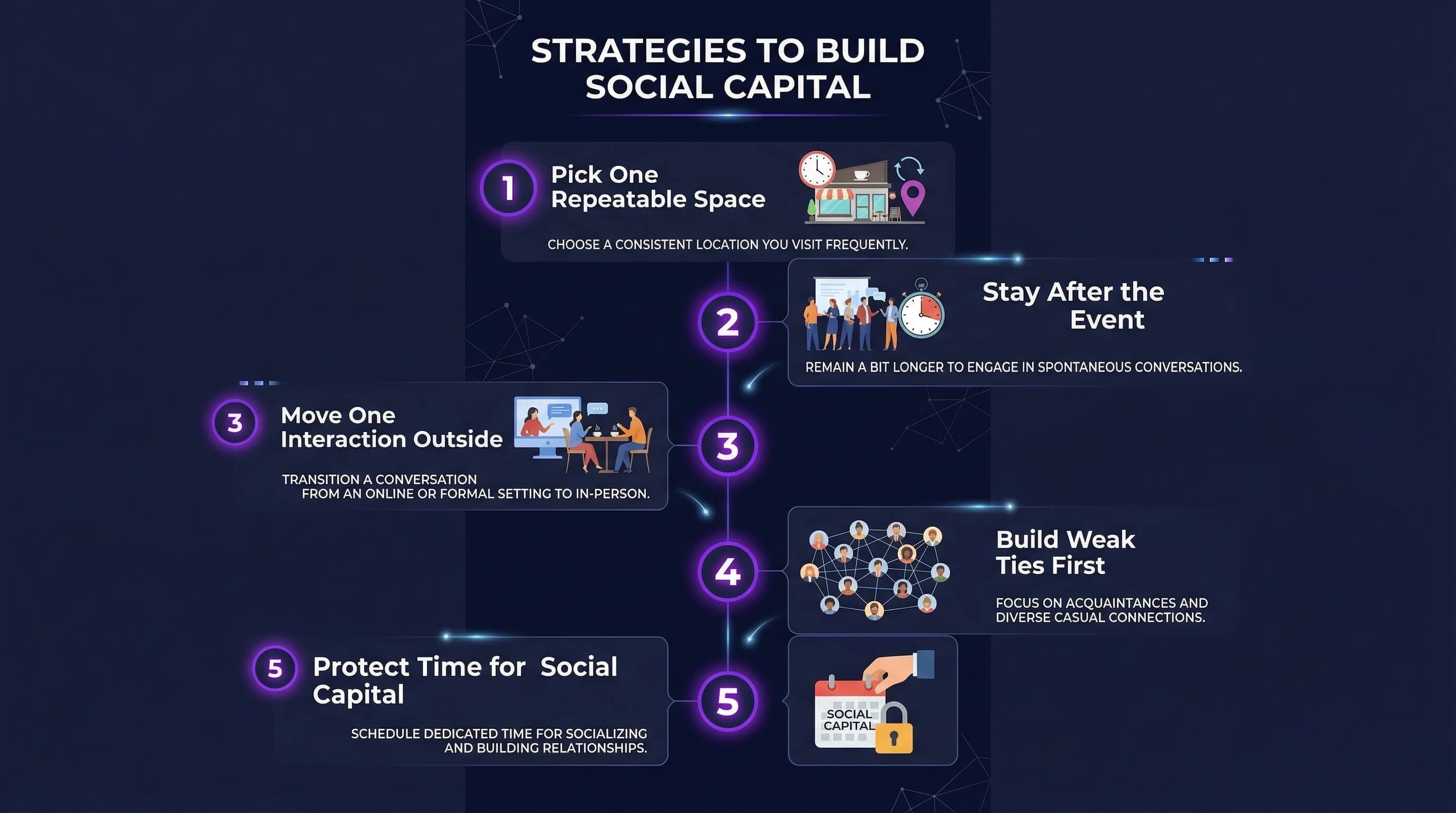
This is not about forcing conversations. It is about engineering exposure.
1. Pick One Repeatable Space
Gym class. Running club. Book club. Creative workshop. Community event. Commit to going once a week, to the same place, at the same time.
Consistency always beats intensity.
Not sure where to start? Browse our upcoming weekend workshops and group events in Delhi designed exactly for this.
2. Stay After the Event
The real conversation rarely happens during the activity; it happens immediately after. Get tea after. Take a walk after. Join the post-session hangout. This specific window is where an acquaintance converts into a friend.
3. Move One Interaction Outside the Original Context
Invite someone for coffee. Share a meme. Suggest a second meet.
Research shows that friendship deepens when interaction moves beyond institutional boundaries.
4. Build Weak Ties First
You do not need 5 best friends immediately.
You need 10 familiar faces.
Weak ties reduce loneliness even before deep friendship forms.
5. Protect Time for Social Capital
Robert Putnam's work on social capital shows that networks and trust enable collective wellbeing.
Treat friendship-building like gym membership. It requires maintenance.
You Are Not Behind
The cultural narrative says by 30 you should have "your people."
But Delhi in 2025 is not Delhi in 1995.
Migration is higher. Work hours are longer. Digital substitution is stronger.
Loneliness is not a personal failure. It is a structural outcome.
And structures can be redesigned.
Sources & Research
This article draws on peer-reviewed and publicly available research, including:
- Hall, J. A. (2018). Journal of Social and Personal Relationships
- Ipsos Global Survey on Loneliness (2020; reporting via Scroll.in, 2025)
- PMC Scoping Review on Loneliness in India (2024)
- Ministry of Health and Family Welfare India household structure data (2019-2021)
- Granovetter, M. (1973). The Strength of Weak Ties
- Science (2022). Causal analysis of network bridging ties
Where Delhi NCR specific adult friendship data was unavailable, national urban statistics were used as directional indicators.
A Quiet Next Step
If this resonated, do not overthink it.
Pick one repeatable space this week. Show up twice. Stay after.
Connection compounds.
Read Next
- Modern Loneliness in Urban India
- Why Gen Z Feels Lonely in a Hyper-Connected World
- Where to Find Third Places in Delhi NCR
Frequently Asked Questions
How long does it really take to make a close friend as an adult?
It takes over 200 hours of quality, intentional interaction to form a close adult friendship. According to research from the University of Kansas, casual friendships require 40 to 100 hours. The key variable to speeding this up is spending time together outside of purely functional settings, like the office.
Is loneliness worse in big cities like Delhi?
Yes, structural factors in megacities like Delhi-NCR increase the likelihood of loneliness. While specific adult datasets for Delhi are rare, urban migration, the rise of nuclear families, and notoriously long commutes create structural isolation. Nationwide, 43 percent of urban Indians report experiencing loneliness at least sometimes.
Can friendship apps solve adult loneliness?
Friendship apps are useful for initiating contact, but they cannot replace repeated offline interaction. While apps can help you find initial weak ties, research indicates that excessive passive screen time correlates with higher loneliness. Real depth is built through consistent, in-person shared experiences.
What if I am an introverted adult trying to make friends?
Introversion is not a barrier to friendship; lack of frequency is. If you are introverted, prioritize smaller, structured group formats like book discussions or skill-based workshops. Consistency in showing up matters far more than having an extroverted personality.
